
PTSD is a form of Brain Injury
We’ve handled quite a few cases where providers have diagnosed PTSD.
It’s always been treated by providers as a psychological injury.
But the way it’s currently understood in science and medicine means it should really be re-framed as a brain injury that affects people psychologically and causes emotional distress.
There is a lot of brain science associated with PTSD. And it confirms that the fear that leads to PTSD is the catalyst for a neuro-chemical reaction that changes the brain.


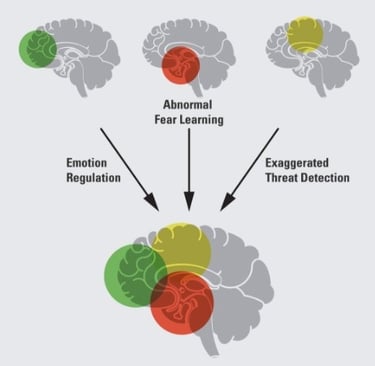
The neuro-chemical reaction started by the near-death or similar experience changes the brain by atrophying the pre-frontal cortex and the hippocampus. This affects executive function, memory and cognition.
Because of these changes, the brain processes information differently.
The amygdala is the fear center. Some people call it the smoke detector for the brain.
In a healthy brain the hippocampus regulates the amygdala. It tells it, when appropriate, to calm down. It’s just the popcorn. The house isn’t on fire.
But PTSD compromises the hippocampus. And when the hippocampus is impaired it doesn’t do a good job shutting off the amygdala when there’s a false alarm.
The consequence is hyper-vigilance. The brain over-releases its stress chemicals like cortisol, adrenaline and norepinephrine. The person is exhausted. They’re always on the lookout for danger. And any sensory trigger sends the person into a full panic attack.
Eventually the person retreats. They “emotionally numb” themselves. They don’t want to get “too high” when doing enjoyable things because then the lows are even more upsetting. They become emotionally flat and take less joy in family and friends. It begs the question: How much must people with PTSD hurt to want to give up the joy they used to feel to avoid the terror they now feel?
When PTSD co-occurs with mTBI it—as you probably suspected—makes both injuries much worse. (Also, it shouldn’t be treated as a secondary diagnosis—it is a type of brain injury distinct from concussion.)
Anyway, I think that looking at PTSD as a brain injury with emotional sequelae is a much better construct than lumping the symptoms together with the injury itself.