
Brain Injury isn’t Binary (and a Related Success Story)
For most of my career traumatic brain injury has been all or nothing. There is either a concussion or there isn’t. That’s been the end of the story.
But that doesn’t line up with common sense or what we know about the brain. We know that there are brain injuries that don’t cause the symptoms that are used to diagnose concussion (i.e., loss of consciousness, amnesia or altered mental status).
A person can sustain a biologically meaningful injury to the brain without meeting the classic clinical criteria for a concussion diagnosis.
There are lots of injuries that don’t produce a global disturbance of consciousness but still cause cellular, axonal, vascular, inflammatory, vestibular, ocular-motor or network damage/dysfunction.
Neurologists use the term “sub-concussive” to describe forces that don’t produce classic concussion symptoms but still cause measurable physiological or structural effects on the brain.
Part of the reason that an impact may not cause a concussion but still causes injury is that the brain isn’t homogeneous. Different neural systems have different tolerances, metabolic demands, blood supply vulnerabilities and biomechanical susceptibilities.
Rotational acceleration might disrupt pathways that control eye movements without impairing consciousness. That is why some people don’t necessarily meet criteria for diagnosing “concussion” but still develop symptoms like:
Convergence insufficiency
Photophobia
Visual motion sensitivity
Dizziness
Cognitive fatigue
Headaches
Impaired attention
Convergence insufficiency is a good example for two reasons. First, it’s one of the few symptoms of sub-concussive brain injury that can be objectively measured. Second, it illustrates how sensitive certain parts of the brain are to disruption.
Convergence requires coordinated activity among various parts of the brain. These parts of the brain and the “network” that connects them can be disrupted by axonal strain, microvascular dysfunction, metabolic disruption, neuroinflammation, impaired connectivity or errors in network synchronization.
Small disruptions in these systems can impair convergence even when consciousness is not affected.
Convergence insufficiency tells us more than that the eyes aren’t working together. Convergence insufficiency is basically a canary in the coal mine.
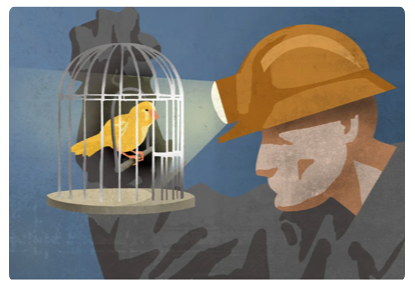
It tells us that there were/are harmful forces at work even though they may not be “visible” on a CT scan, MRI, or in the form of classic “concussion-like” symptoms.
Convergence insufficiency is just one example. There are all sorts of other brain injury symptoms that don’t line up with concussion diagnoses but can have significant and long-term impacts on the injured person.
Success Story
We arbitrated a case recently. There was no concussion diagnosis from really anyone (other than, perhaps, the chiropractor).
The other side put on three “expert” witnesses including a biomechanical engineer and a neurologist (who was featured in the movie Concussion and played by Alec Baldwin).
But the defense experts couldn’t get around convergence insufficiency and its role, in this case, like the canary in the coal mine. They were still like two-dimensional ants unaware of the three-dimensional world in which they lived. For them it was all or nothing. Either there was a concussion or there was no brain injury.
But that isn’t how it works. Brain injury is not binary. And just because you don’t have one particular type of brain injury doesn’t mean you don’t have another.
Fortunately the arbitrator understood the logic. He awarded 500 percent more than the defendant’s top offer and 250 percent more than the defendant’s insurance limits. Because there was an “open policy” the insurance company is stuck paying an award that’s much greater than the amount of coverage purchased by the defendant.